Walsall Operatic Society brings humour, heart and an exceptionally talented ensemble to the Garrick in a musical whose fight for fairness still has something important to say nearly 60 years later.
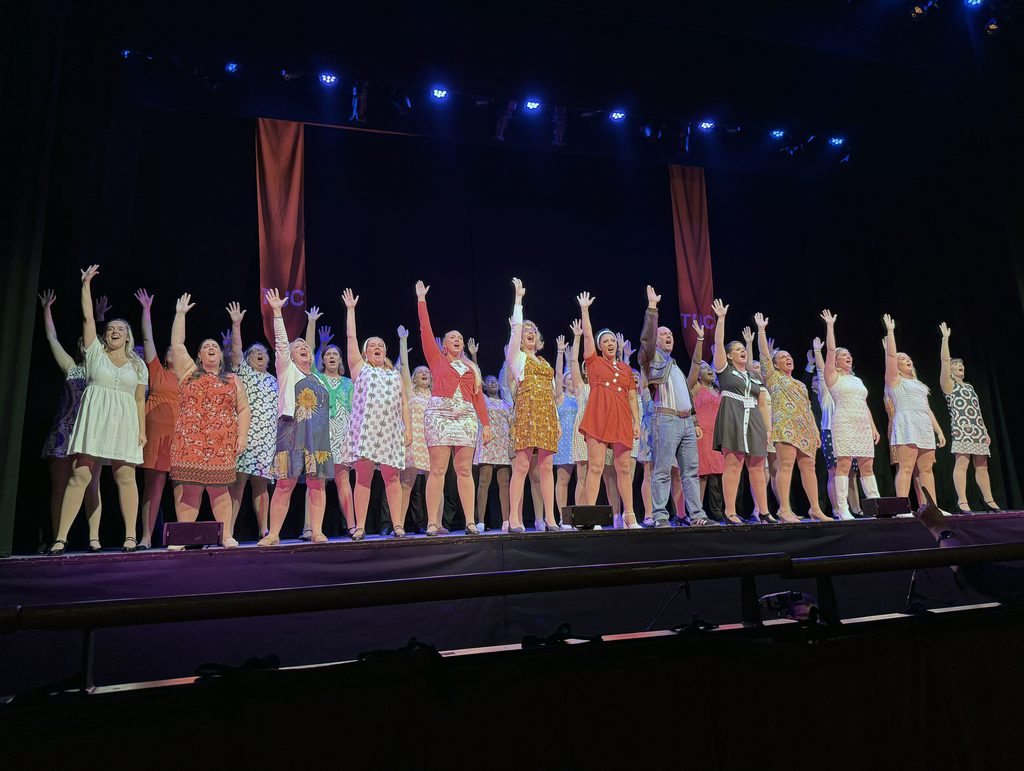
I went to the Lichfield Garrick on Thursday night with my wife to see Walsall Operatic Society’s Made in Dagenham, having met several members of the company through Lichfield Radio. I already knew they were hugely entertaining people. What I wasn’t quite prepared for was just how accomplished they would be on stage.
Walsall Operatic Society has been around since 1955 and has a particularly long relationship with Lichfield, moving its main stage productions to the old Lichfield Civic Hall in 1985, the venue that would eventually become the Garrick. More than 40 years later, that relationship is clearly still thriving. Thursday’s performance was to a packed house, and deservedly so.
For anyone unfamiliar with the story, Made in Dagenham is inspired by the women sewing-machinists at Ford’s Dagenham plant in 1968. In the musical, Rita O’Grady finds herself leading her colleagues into battle after their jobs are reclassified as ‘unskilled’, with their fight eventually becoming much bigger than the factory floor. The musical – with a book by Richard Bean, music by David Arnold and lyrics by Richard Thomas – is ultimately about ordinary people finding the courage to stand together and demand fairness.
And that, more than anything, was what stayed with me.

There are some deliberately broad stereotypes along the way. The men can be spectacularly stupid, the women are frequently underestimated and downtrodden, and the portrayal of America is so gloriously over-the-top that, viewed through the prism of 2026, it inevitably takes on an additional contemporary resonance. The piece is firmly time-stamped in the late 1960s, though, and I think it has to be viewed in that context.
What emerges underneath the comedy is something much more interesting about bullying, power and what happens when ordinary people decide that something simply isn’t fair.
The strike also comes at a cost. Rita’s husband Eddie supports her until the pressure of her increasingly consuming campaign begins to affect their family, while the women’s action has consequences for thousands of other Ford workers. That tension stops the story becoming quite as straightforward as heroes versus villains. As I found myself thinking during the performance, when a relatively small group takes action to defend the rights of many, there is always the risk that everyone pays the price if they lose.
There were elements of the gender comedy that sat less comfortably with me. Having worked in offices through the 1990s and 2000s particularly, I remember the sexism, the gender imbalance and that peculiar ability people had to be politically correct publicly while behaving very differently behind closed doors. Some of that hasn’t entirely disappeared.

But neither has the central issue, which is why the story still matters. As I said afterwards, it is “another reminder of how tough it was for women, and still is for women, to just be treated equally.”
As a production, however, this was an absolute joy.
Musically and chorally the company was exceptional. I deliberately don’t want to single out individual performers because this really did feel like an ensemble achievement. The standard across the cast was extraordinarily high, genuinely the sort of quality you might expect to travel to London to experience.
Director Steph Coleman, Musical Director Ian Room and Choreographer Cat Sambrook have marshalled a substantial company into something that feels remarkably assured. The large ensemble numbers have scale and energy, but the production also knows when to be quiet. Among all the laughs are moments of genuine tenderness and emotion, and those were some of the strongest moments of the evening.
Being seated very close to the front also gave me a perspective I don’t normally get. I could watch Ian conducting the orchestra and see him physically cueing Rita, played by Louise Hewitt, into musical passages. Watching that relationship between performer and orchestra at such close quarters was fascinating and gave me a new appreciation of just how much communication is going on beneath a musical that the audience ordinarily never notices.
Visually it works beautifully too. The lighting moves effectively between brightness and darkness, while the simple blocks of colour give the production an almost cinematic quality at times. The blue Ford overalls punctuated by the browns and muted tones of management create a strong visual identity without the stage ever becoming unnecessarily complicated.
And it is very funny.
Some jokes deliberately sail close to the wind and there were moments when I found myself thinking, “that’s funny, but it’s not”, only for the audience behind me to erupt. Comedy changes with time and audiences, and judging by Thursday night’s reaction, plenty of it landed exactly where it was supposed to.
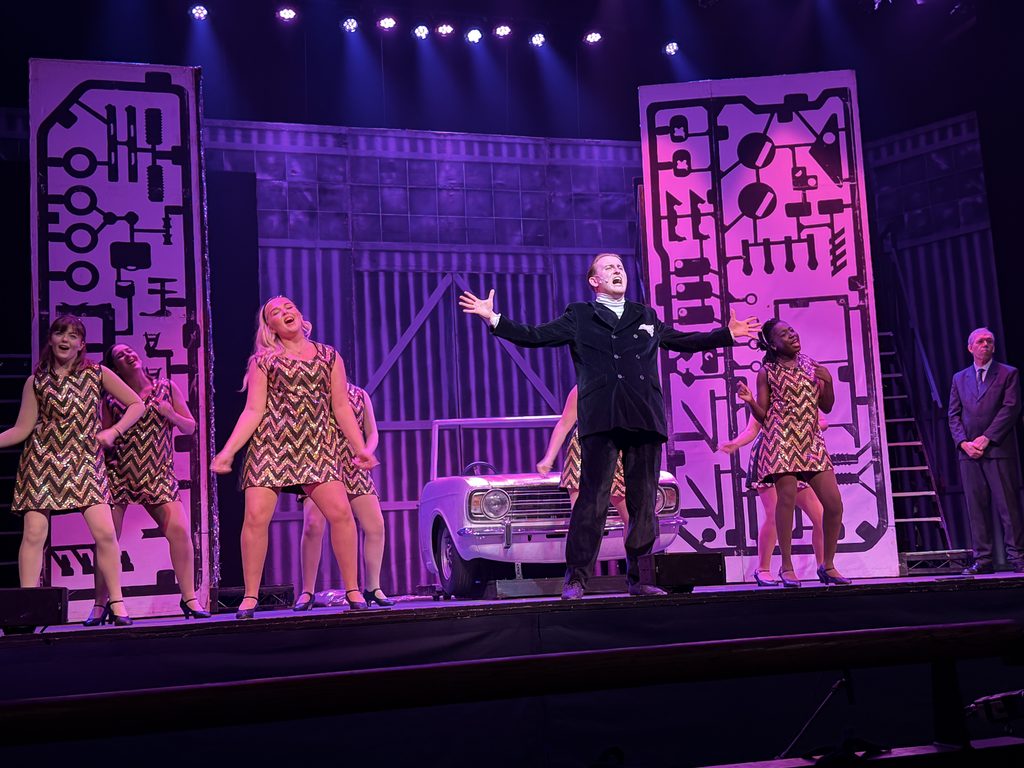

Ian Shephard’s portrayal of Prime Minister Harold Wilson was particularly funny, as was Vicki Hardy as Barbara Castle, the formidable Secretary of State for Employment and Productivity who, in real life, intervened in the Dagenham dispute and helped bring the strike to an end. The musical takes considerable comic liberties with both, but their scenes provided some of the biggest laughs of the night.
The Garrick itself also deserves a mention. Downstairs was buzzing and packed, while upstairs still offered enough space to escape for a quieter drink. Most importantly for a production like this, the sound was excellent. The balance between the orchestra and a large company was exceptionally good, allowing both the power of the ensemble and the more intimate moments to come through.
What impressed me most was that Walsall Operatic Society never allowed the politics of the story to overwhelm its humanity. This is ultimately about people finding the courage to stand up to something bigger than themselves, while discovering that doing the right thing can be messy, difficult and personally costly.
My immediate reaction after leaving was very simple: “Go see it.”
Made in Dagenham is funny, moving, beautifully performed and, occasionally, deliberately uncomfortable. Above all, Walsall Operatic Society demonstrates once again that you don’t need to head for the West End to find musical theatre performed to an exceptional standard.
Sometimes it’s right here in Lichfield.
There are two more performances at the Garrick on Saturday 3 October at 2:30pm and 7:30pm.
Get your tickets here.